World Cup Prediction Markets Pass $5bn, Expose Near-$9m Loss
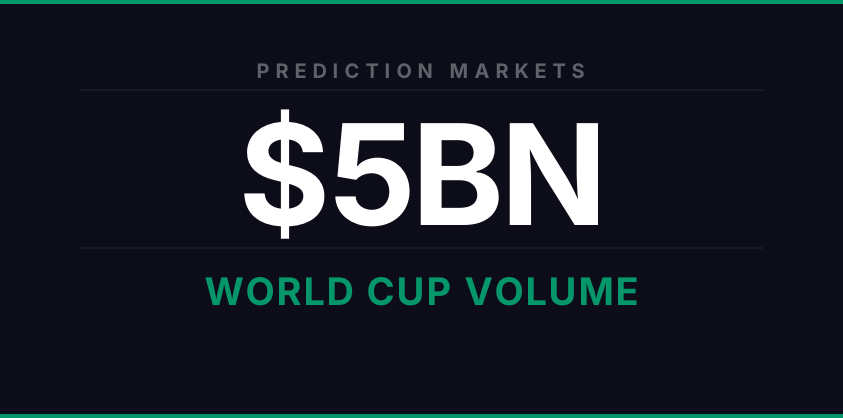
World Cup markets on Polymarket’s international exchange and US-regulated Kalshi Inc. passed $5bn in trading volume in 2026, according to a Bloomberg analysis of Dune Analytics data and company records. Users are trading match results, the Golden Boot market and whether Donald Trump will attend the final.
One Polymarket user lost nearly $9m on a bet that Belgium would beat Egypt. The largest profitable World Cup trade came from an account called “GRIMDRIP,” which turned $6m into $13.6m through two wagers on Czechia versus South Africa.
The 104-match tournament still has group-stage matches and the knockout rounds ahead. Kalshi CEO Tarek Mansour said at a Bloomberg event on Tuesday that the World Cup and NBA Finals helped the company record its first three-day streak of daily trading volume above $1bn. “Everything we’re seeing through the World Cup so far suggests that prediction markets are continuing on an aggressive growth trajectory,” said Chris Grove, an analyst at Eilers & Krejcik Gaming.
DraftKings Sees Record Event-Contract Weekend
DraftKings, which expanded into prediction markets in 2025, said last weekend was its biggest for event contracts to date, surpassing its Super Bowl activity in February. Total customers rose more than 200% compared with the previous weekend, and volume increased 100% over the same period.
Prediction markets let gambling companies such as DraftKings reach consumers in US states where traditional sports betting is prohibited, including California and Texas. Jordan Bender, a gaming equity research analyst at Citizens, said this gives operators access to users they could not previously target through sportsbooks. “Basically the phenomenon that’s happening here is it’s a free-for-all,” Bender said.
Both DraftKings and Kalshi have spent heavily on social media and TV ads to acquire customers. DraftKings promotes its “sports app” as available nationwide. Kalshi has worked with athletes during the tournament, including Luka Modrić and Lionel Messi.
Public Trading Data Shows Winners and Gaps
The relative transparency of some prediction market exchanges gives a rare view into World Cup betting activity that traditional sportsbooks and betting operators do not provide. But profits are not the norm: research by Bender and his Citizens colleagues found that retail customers on prediction markets typically lose money over the long term and perform worse than bettors using sportsbooks.
Of the 20 most profitable wagers on Polymarket’s non-US exchange over the past seven days, only two had no connection to the World Cup. France’s Kylian Mbappé is the favourite in the Golden Boot market. In the Trump final-attendance market, 87% say yes.
Other profitable trades included “mintblade,” who doubled their money with a $7m bet that Iran would not beat New Zealand, and “endlessFate,” who made $5.6m on the Saudi Arabia-Uruguay fixture and another $2.7m on Colombia beating Uzbekistan. The same account lost $1.2m on whether the US and Paraguay would draw.
The data does not show every position. Users can run multiple accounts on Polymarket, the international exchange runs no identity checks, and traders may hedge elsewhere, including on traditional sportsbooks and US-regulated prediction market platforms.
💡TGJ Take
The World Cup is turning prediction markets into a sports betting acquisition channel, not just a niche trading product. For operators, the appeal is clear: event contracts reach users in states where sportsbooks cannot. The problem is that public whale losses create a reputational risk traditional sportsbooks rarely face in such visible form. Affiliates should treat “prediction market” traffic with caution, because the conversion upside now sits next to visible retail-loss risk.