Finland Sets 2% Income Cap as Benchmark for 2027 Market Opening
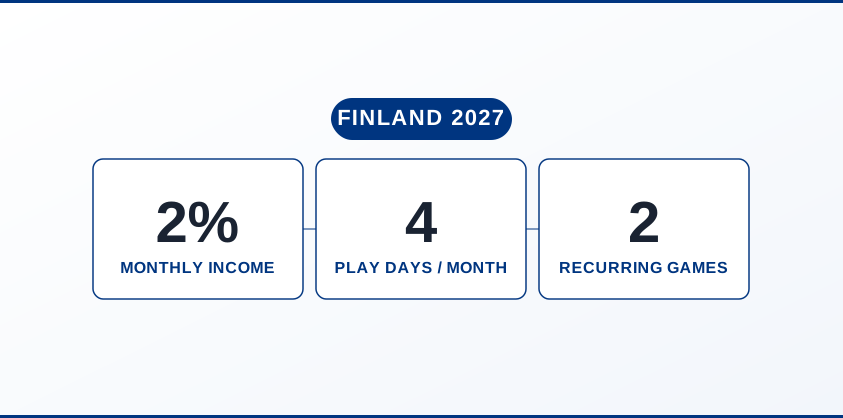
Finland’s National Institute for Health and Welfare (THL) introduced a lower-risk gambling benchmark in March 2026: 2% of monthly net income, four gambling days per month, and no more than two recurring game types. The rule is called “2-4-2.” It comes with a self-assessment test and is framed as a personal spending limit rather than a legal cap.
The timing matters. Parliament adopted Finland’s new Gambling Act on 16 December 2025. The President approved it on 16 January 2026, according to the Ministry of the Interior. Licence applications opened through the National Police Board on 1 March 2026. Licensed betting, online casino, slots and online bingo services can launch from 1 July 2027, ending Veikkaus’ monopoly in those segments.
Veikkaus keeps its monopoly over lottery games, scratch cards, physical slot machines and land-based casino games. Until the end of June 2027 it also remains the only company permitted to provide or market gambling services in Finland. From July 2027, licensing and supervision shift to the new Finnish Supervisory Authority.
The Ministry states the reform’s goal is to cut gambling harm and raise the channelling rate, the share of play that runs through licensed, supervised services. Marketing will be allowed under the new framework. It will face restrictions on prohibited tools, mandatory information, sponsorships and a ban on direct marketing to excluded players.
Finland’s channelling problem is acute compared to its neighbours. Norway and Denmark already report channelling rates above 90% under their current frameworks, while Finland’s rate sits closer to 48% ahead of the reform. Norway offers the closest regional precedent for THL’s approach: Norsk Tipping became the first operator globally to enforce a mandatory monthly loss limit back in 2016, a measure later extended to horse racing betting in 2021. Finland’s 2-4-2 guidance follows a similar public-health logic, but applies it as a national benchmark before licensing even opens, not after a monopoly operator builds it into product design.
Bonusetu.com, a Finnish casino comparison site, says the 2-4-2 model only works with accurate player identification. Acting CEO Tommi Korhonen said bank ID lets operators verify identity, age and play history before a player stakes money. A spend guide or frequency limit has no effect if the operator cannot confirm who is playing. “No registration” casino flows can skip the signup form, but identity checks still happen at the point where bank credentials are required.
💡 TGJ Take
The 2-4-2 rule has no legal teeth, but it sets the standard regulators will measure operators against once licensing starts. Finland’s 48% channelling rate is the real warning sign here, not the spending guidance itself. Treat this market like a standard acquisition opportunity and you will collide with a system designed around harm metrics, not signup volume. Operators should build identity verification, play monitoring and marketing compliance into their Finland rollout from day one. Affiliates running “no registration” campaigns need to drop that framing here specifically. Finnish players skip a signup form, not a bank ID check.