PAGCOR Sees Up to 19% Philippines GGR Drop as E-Gaming Pulls Back
PAGCOR Chair Alejandro Tengco expects 2026 GGR to fall to PHP 320–350 billion as e-wallet restrictions and inflation squeeze mass-market demand.
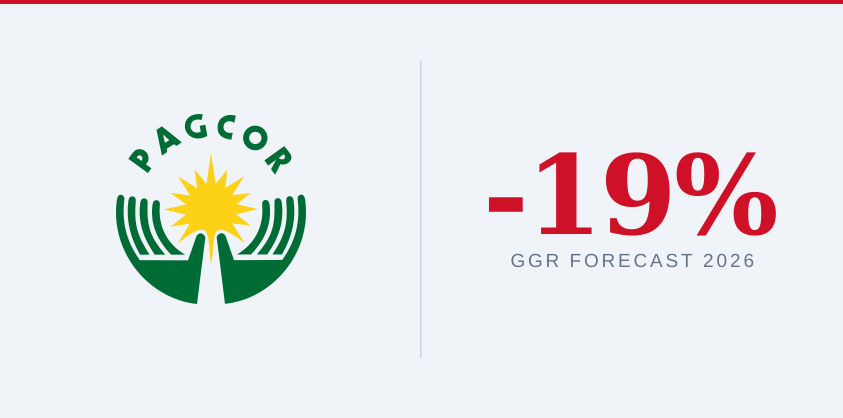
PAGCOR Chair and CEO Alejandro Tengco has warned that Philippine gaming GGR could fall by as much as 19% in 2026. The market reached PHP 396.14 billion in 2025. Speaking on the sidelines of the SiGMA Asia Summit in Manila, Tengco put his full-year forecast at PHP 320–350 billion.
He named two drivers behind the weaker outlook. One is the BSP’s directive requiring the delink of online gambling platforms from e-wallets. The other is the Middle East conflict, which Tengco said is weighing on household spending more heavily than the payment restrictions alone.
The Q1 numbers confirm the direction of travel. Philippine gaming GGR fell 15.8% year-on-year to PHP 87.60 billion, down from PHP 104.12 billion a year earlier. The electronic gaming segment fell 22.43% over the same period. Licensed casinos led Q1 with PHP 44.52 billion, equal to 50.83% of total GGR, while electronic gaming produced PHP 39.90 billion, or 45.55%. The reversal is sharp: electronic gaming accounted for 50.77% of total 2025 GGR and had overtaken licensed casinos as the largest segment for the full year.
Tengco told reporters that lower-C and upper-D income groups, which drove online growth, are now prioritising food and basic necessities before placing bets. That is a demand shift, not just a payment access problem.
The macro backdrop is not improving. Philippine inflation hit 7.2% in April 2026, the second consecutive month above the BSP’s 2%-4% target. The BSP raised its key rate to 4.5% in April, its first tightening in two years, and lifted its full-year inflation forecast to 6.3%. Ser Percival Peña-Reyes, Senior Research Fellow at the Ateneo Center for Economic Research and Development, told BusinessWorld that elevated inflation and weaker consumer confidence are likely to keep gaming revenues subdued in the near term.
Tourism is the partial offset for land-based operators. Foreign arrivals reached 2.24 million between January and late April, up nearly 9% year-on-year. Mainland China arrivals rose sharply through April, supported by visa-free entry and e-visa rollout, while South Korea fell 6.18% to 440,827 and slipped to second place behind the United States in April. South Korean visitors have historically been among the highest-spending casino customers at Entertainment City properties.
💡 TGJ Take
The Philippines built its 2025 GGR record on electronic gaming a segment, that grew 30% year-on-year and crossed 50% of total market revenue for the first time. That segment is now in structural retreat, hit simultaneously by a payment policy that raised friction for licensed operators and by inflation that cut discretionary budgets at exactly the income level that fuelled online growth.
For operators, investors, and regulators watching other Asian markets, the Philippines in 2026 is a live stress test of what digital-led GGR looks like when conditions turn. The lesson is not that e-gaming is fragile. It is that mass-market digital revenue has concentrated dependencies in payment rails and in consumer spending power, that land-based premium revenue does not share to the same degree.