
Italy’s Bingo Fee Model Collapses After EU Ruling Backs Operators
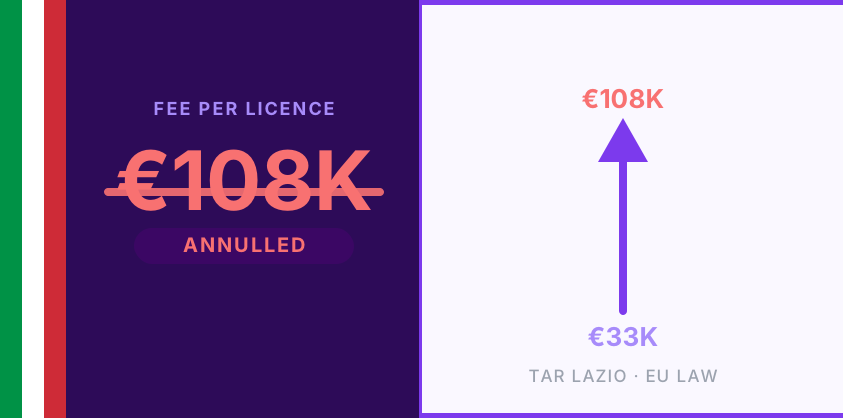
Italy’s Regional Administrative Court (TAR Lazio) has annulled the government’s increase in bingo concession fees, ruling that the pricing model conflicts with EU law following a recent Court of Justice of the European Union (CJEU) judgment. The decision overturns a decree issued by the Customs and Monopolies Agency (ADM) that had sharply raised annual concession payments during an extension period.
The measure raised the annual fee from about €33,000 to €108,000 per licence. It introduced a flat charge that applied equally to all operators, without considering their revenue levels. TAR Lazio rejected that structure, pointing to EU law and the need for fees to reflect actual economic activity rather than a fixed amount.
That position draws directly from the CJEU ruling in joined cases C-728/22 to C-730/22. The court examined Italy’s handling of bingo concessions and set clear limits on how member states can structure fees. It found that uniform charges disconnected from revenue are not acceptable, and that extending licences without proper market access raises further legal issues. TAR Lazio relied on those findings when reaching its decision.
Italy has relied on repeated extensions of existing bingo licences instead of launching new tenders. During those periods, ADM introduced higher fixed fees to maintain public income. Operators challenged both elements, arguing that the system treated them equally despite different performance levels and restricted access for potential entrants.
With the increase now annulled, the current model loses part of its financial basis. The extension system depended on those higher payments. Without them, the pressure shifts toward organising a formal tender rather than continuing with temporary renewals.
The case points to a wider tension. Governments look for predictable revenue from licences, but EU law places limits on how that can be structured. A fixed fee may be simple to apply, yet it becomes difficult to defend if it does not reflect operator activity or limits competition.
For operators, the decision reduces immediate costs and clarifies how fees should be assessed. For ADM, it creates a gap between existing measures and EU requirements that will need to be addressed through new rules or a revised concession process.
TGJ Take
Italy’s bingo model has been running on extensions and fixed fees for years, and this ruling breaks that structure. Operators gain short-term relief, but the bigger shift is structural. A new tender process now looks unavoidable, and that resets the market for anyone looking to enter or expand. For existing licence holders, this is no longer about defending current terms but preparing for competition. Affiliates tied to bingo brands should expect changes in market share once new licences come into play.